
What Should an HVAC Annual Maintenance Plan Include for Commercial Buildings in Dubai?
HVAC annual maintenance services in Dubai exist for a simple reason: commercial buildings here ask a great deal of their cooling equipment. Systems run long hours, occupancy shifts through the day, and tenants expect the same comfort in August as in January. Waiting for something to fail and then calling a contractor is one way to cope. A structured plan is the other, and it swaps scrambling for scheduling. This guide breaks down what a commercial plan should actually contain, how to organise it across a building, and what to check before you sign with a provider.
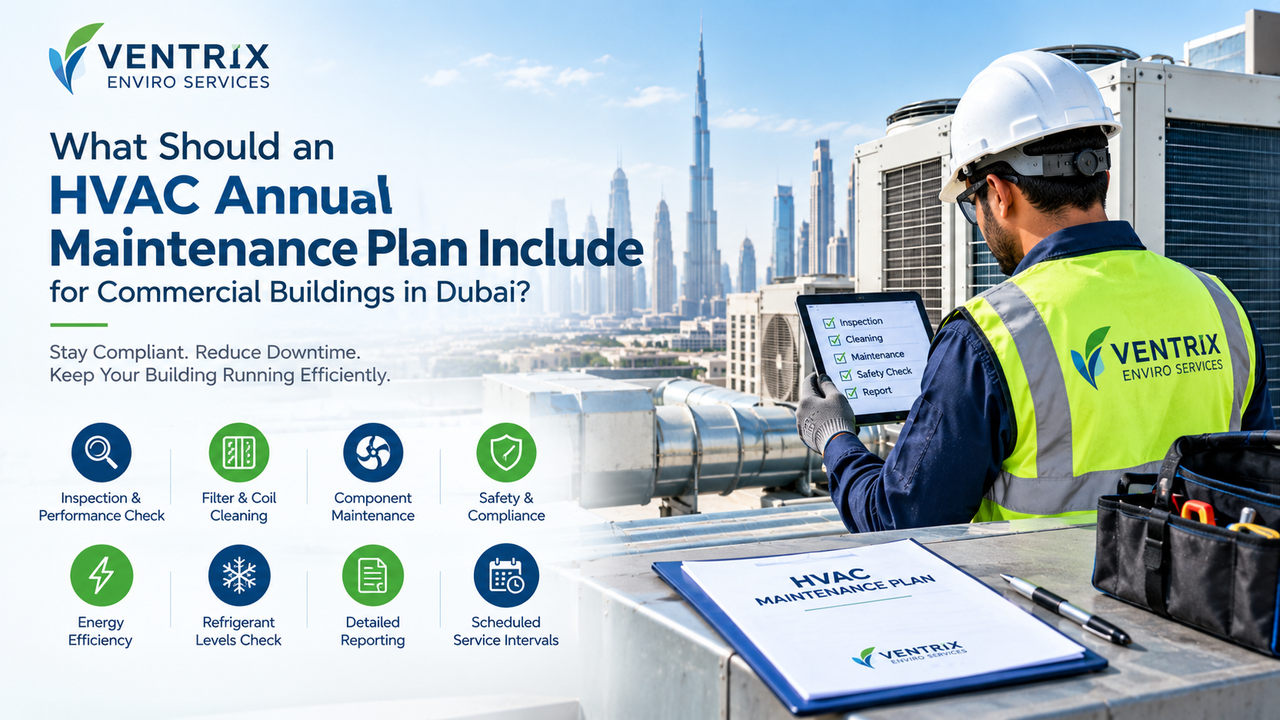
Quick Answer
A solid HVAC maintenance plan for commercial buildings covers scheduled equipment inspections, filter and coil checks, airflow and cooling performance readings, electrical and mechanical component checks, drainage inspection, and written reports. The exact scope depends on the equipment, manufacturer guidance, and the building's needs.
1. What Should an HVAC Annual Maintenance Plan Cover?
An HVAC maintenance plan for commercial buildings is a written scope of work, not a vague promise to look after the AC. Use the annual HVAC maintenance checklist below as a baseline when you review any proposal for HVAC annual maintenance services in Dubai.
☐ Scheduled equipment inspections. Planned visits with a defined list of assets and tasks.
☐ Filter and coil condition checks. Inspection, and cleaning where the condition calls for it.
☐ Airflow and cooling performance assessment. Readings taken and compared against what the equipment should deliver.
☐ Electrical and mechanical checks. Motors, fans, belts, connections, and controls.
☐ Drainage and condensate inspection. Drain pans, lines, and signs of leaks.
☐ Fault reporting and documentation. Findings recorded and shared after every visit.
Air handling units, fan coil units, and split AC units can all sit in the same building and still need different attention. That is why the exact scope depends on the system type, manufacturer recommendations, equipment condition, and what the building actually requires. A plan copied from another property rarely fits, and the better HVAC annual maintenance services in Dubai are written around the equipment actually installed.
2. How Often Should HVAC Equipment Be Inspected in Commercial Buildings?
HVAC preventive maintenance works best when frequency follows the equipment rather than a template. A chiller running around the clock, a rooftop unit baking in direct sun, and an air handler serving a quiet storage floor do not age at the same speed. Operating hours, occupancy, dust exposure, and each unit's fault history should all influence how often it gets attention.
A helpful way to think about it is two layers. Routine inspections are quick and frequent: a visual check, a few readings, a listen for anything unusual. Comprehensive servicing is deeper and less frequent: cleaning, testing, tightening, and measuring. Treating every component as though it needs the same interval wastes money on some assets and under-serves others.
3. Should an HVAC Maintenance Plan Include Air Filter and Coil Cleaning?
HVAC coil cleaning services and filter care deserve a named line in the plan because they directly affect how hard the system has to work. HVAC filter and coil cleaning is not something to leave as an assumed extra, since a plan can quietly exclude it and you only find out when performance slips.
On the filter side, the plan should say how filters are inspected and when they are replaced. A loaded filter restricts airflow and pushes fans and compressors to compensate. On the coil side, technicians should check both evaporator and condenser coils for dirt accumulation, bent fins, and airflow restrictions, then clean based on equipment condition and manufacturer guidance. Dirt on a coil acts as insulation, which is why a system can look healthy and still use more energy than it should.
Ask one direct question when reading any proposal: is cleaning included, or only inspection? Some scopes cover full cleaning, others only flag the problem and quote separately. Neither is wrong, but you should know which one you are buying.
4. What Electrical and Mechanical Components Should Be Checked?
HVAC equipment inspection should reach beyond what is visible from the floor. Where fitted, a thorough plan addresses these components:
- Fans, motors, and bearings. Condition, alignment, vibration, and noise.
- Belts, pulleys, and drives. Wear, tension, and alignment on belt-driven units.
- Electrical connections and controls. Loose terminals, heat marks, and control behaviour.
- Thermostats and sensors. Accuracy and response, since a faulty sensor can make healthy equipment misbehave.
- Refrigerant system indicators. Pressure readings and leak checks where applicable.
- Safety controls and protective devices. Confirming they operate as designed.
Inspection and testing of these items must be carried out by suitably qualified technicians using procedures appropriate to the equipment. This is not a place for improvisation, and it is worth confirming who will actually be on site.
5. Why Should Airflow, Cooling Performance, and Drainage Be Included?
HVAC system performance checks are where a plan proves its value, because they connect equipment condition to what occupants feel. A solid HVAC inspection checklist for buildings includes airflow at accessible supply and return points, temperature performance across zones, visible leaks and condensate drainage, unusual noises or vibration, recurring faults, and comfort complaints from occupied areas.
Professional HVAC duct cleaning is not always part of an annual plan, but airflow readings often reveal when it is needed. If several outlets deliver less air than they should while filters and fans check out fine, the ductwork is the next place to look. A duct camera inspection can confirm the condition before any cleaning is approved.
Mould remediation sometimes begins with an overlooked condensate line. A blocked drain pan overflows slowly, insulation stays damp, and the first sign is a musty smell or a stained ceiling tile. Checking drainage on every visit is a small task that heads off a larger one.
6. How Can Building Managers Create a Practical HVAC Maintenance Schedule?
A preventive maintenance schedule for HVAC starts with knowing what you own. Building maintenance planning falls apart quickly when nobody can say how many units exist, where they are, or when they were last serviced. Start with an asset register that records at least the fields below.
| Field | Why it matters |
|---|---|
| Equipment type and location | Lets technicians find and plan access |
| Model and serial number | Matches manufacturer guidance and spare parts |
| Service history | Shows repeat faults and overdue work |
| Criticality | Decides which equipment gets priority |
| Access and working-hour limits | Avoids disturbing tenants or guests |
From there, set inspection and servicing intervals per asset, schedule work around occupancy and operating hours, and keep a running list of outstanding faults with follow-up dates. Critical equipment, such as plant serving server rooms, clinics, or guest floors, comes first. Hotels and restaurants should also place kitchen exhaust cleaning on the same calendar so every recurring task sits in one view.
Signs your HVAC system needs maintenance still matter even with a schedule in place. A plan sets the rhythm, but a new noise, a hot floor, or an odd bill can justify bringing a visit forward, and the schedule should leave room for that.
7. What Maintenance Reports Should a Commercial HVAC Contractor Provide?
Reports turn a service visit into usable information. Without them, a facility manager has to take it on trust that work was done and has nothing to compare next quarter against. A useful report usually includes:
- The equipment inspected and the work completed
- The condition of important components
- Identified faults and potential risks
- Measurements or test results where relevant
- Recommended corrective actions
- Outstanding issues, with suggested follow-up dates
The format and level of detail should be agreed in the maintenance scope before work starts, not negotiated after the first visit. Over a year, these reports show which units keep returning with the same fault, which helps when deciding between another repair and a replacement budget. Reporting is one of the clearest differences between basic callouts and well-run HVAC annual maintenance services in Dubai.
8. How Can You Choose the Right HVAC Maintenance Company in Dubai?
Commercial HVAC maintenance Dubai providers vary widely in how they scope and deliver work, so compare proposals against the same checklist. When you evaluate an HVAC maintenance company in Dubai, look at:
- Experience with your equipment. Ask about similar buildings and system types they already maintain.
- A clear scope with exclusions. What is included, what is priced separately, and what is not covered.
- Qualified personnel. Who will be on site and what they are trained to do.
- Planned schedules. Visit dates set in advance, not only when you call.
- Reporting and communication. What you receive after each visit and who you speak to.
- Fault response. How quickly they react and whether they recommend corrective work clearly.
Ventrix Enviro Services is one provider you can contact to discuss your building's HVAC inspection and maintenance requirements. Whichever company you choose, HVAC annual maintenance services in Dubai should be agreed in writing, with the scope, schedule, and reporting spelled out before the first visit.
Water tank and pipeline cleaning and AC duct cleaning and disinfection are common add-ons worth discussing at the same time. Coordinating them with the HVAC plan can mean fewer access arrangements for tenants and one calendar for the facilities team.
Build a Maintenance Plan Around Your Building's HVAC Requirements
A useful plan is built from equipment inspections, filter and coil checks, airflow assessments, component testing, a realistic schedule, and proper documentation. None of those is complicated alone. The value comes from doing them in a defined order, on a defined timetable, with records. A generic checklist is a decent starting point, but the plan that works is the one tailored to your building and the equipment in it. Investing in HVAC annual maintenance services in Dubai on those terms gives facility teams more control over when work happens and what it costs.
Frequently Asked Questions
Looking for HVAC Maintenance Support for Your Commercial Property in Dubai?
Contact Ventrix Enviro Services to discuss your building's inspection and annual maintenance requirements.
Call +971 504 558 845 WhatsApp Us Book Online